This project took its roots while researching knitting as an act of
resistance. Diving into the origins of knitting as both a form of
art and a form of craft, I
wrote my master thesis on the topic of knitting as a resistance tool
against the rise of the far right and facist propaganda, white
supremacist ideologies, and over-consumption practices.
As the writing process came to an end, I decided to extend in practice what I preached in theory: radical community building is a an act of resistance, and it requires regularity, repetition, and a safe space to exist.
Now, while Knit Clubs are alive and thriving, they (almost)all have in common
this one thing: people come to work on their own project. My question was then: what
happens when people come together to
work together on a common goal? When they join
skills to make something together? Well, that's what we're trying to
discover with The Commuknit Project.
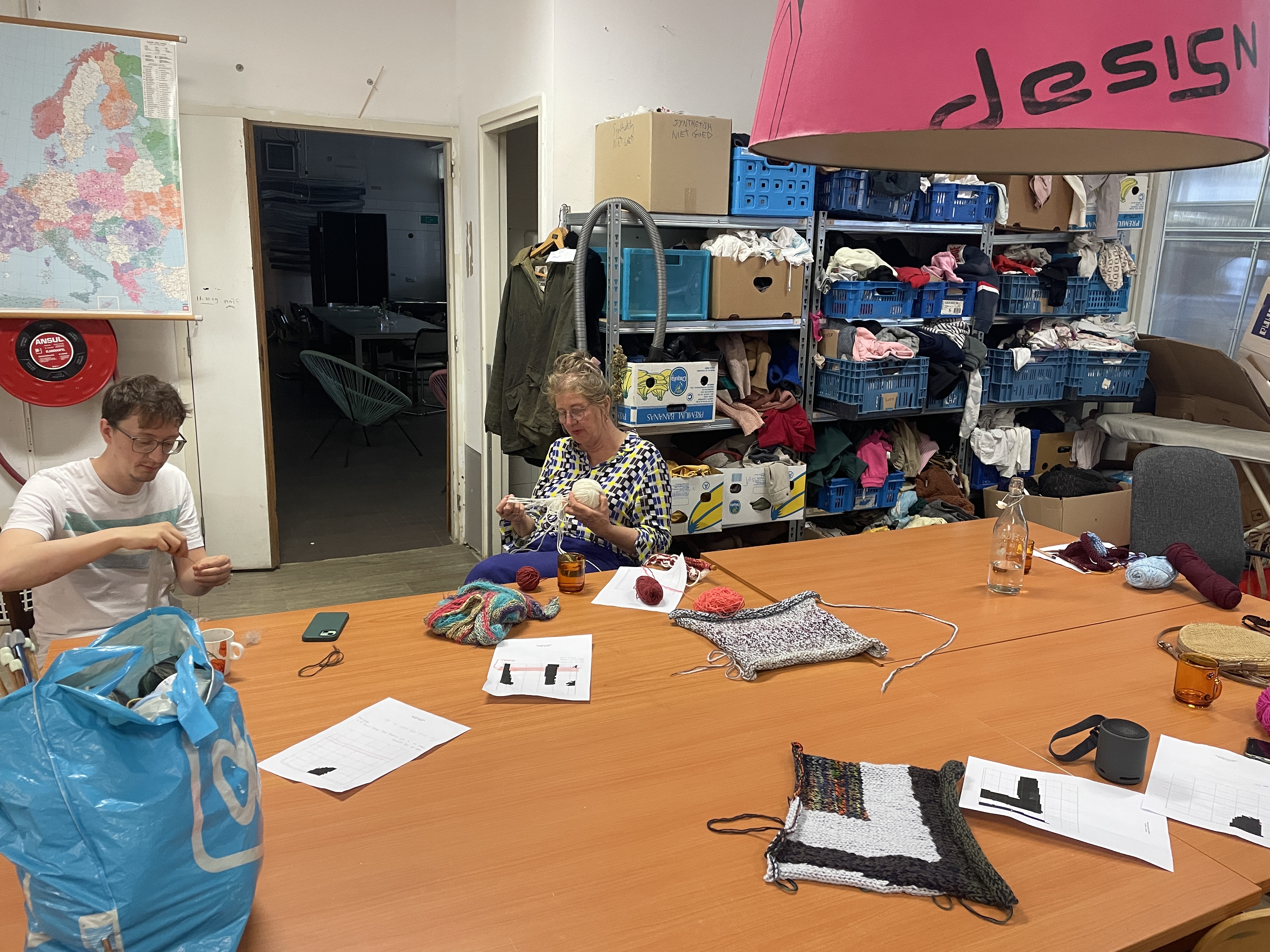
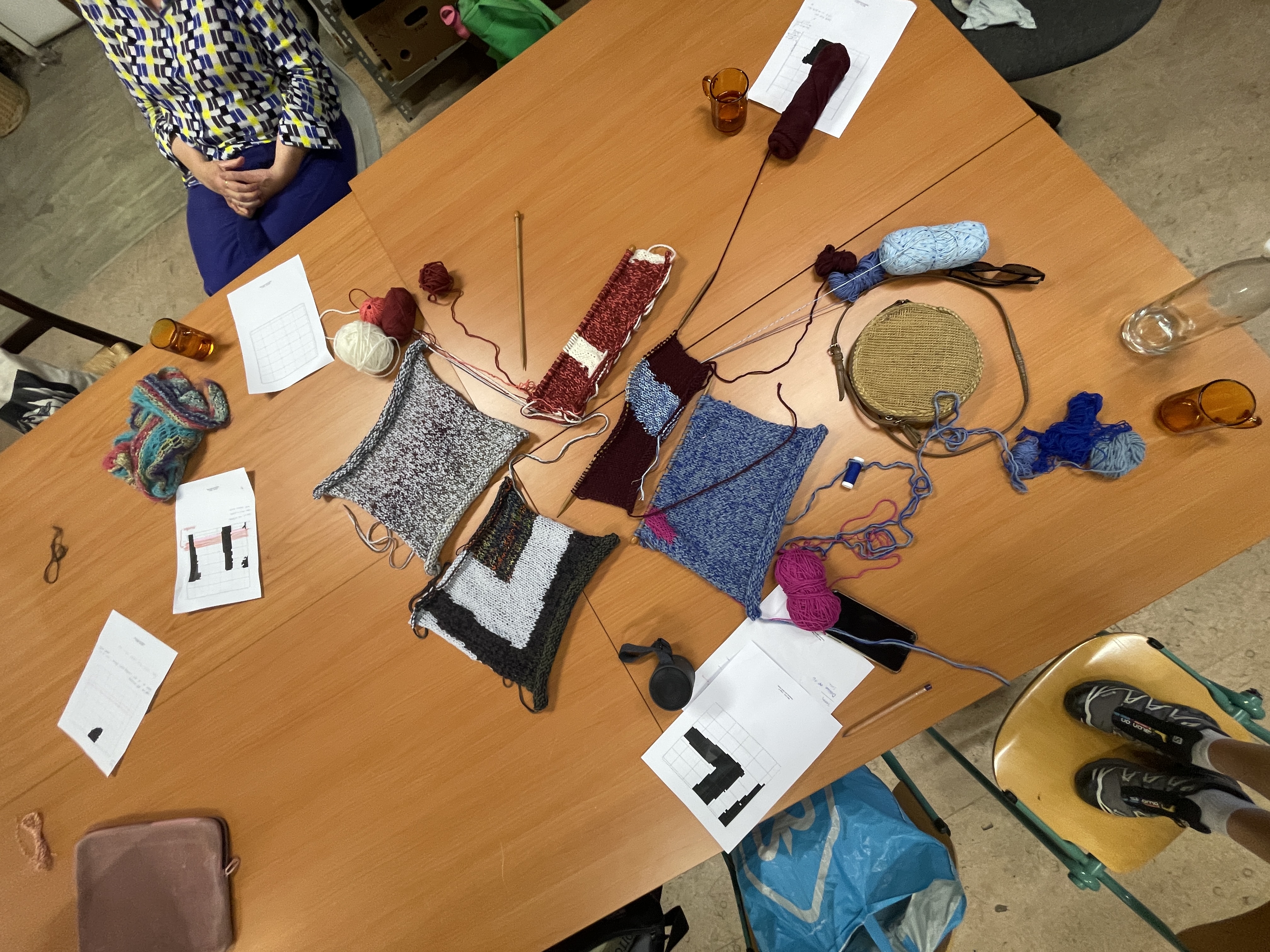
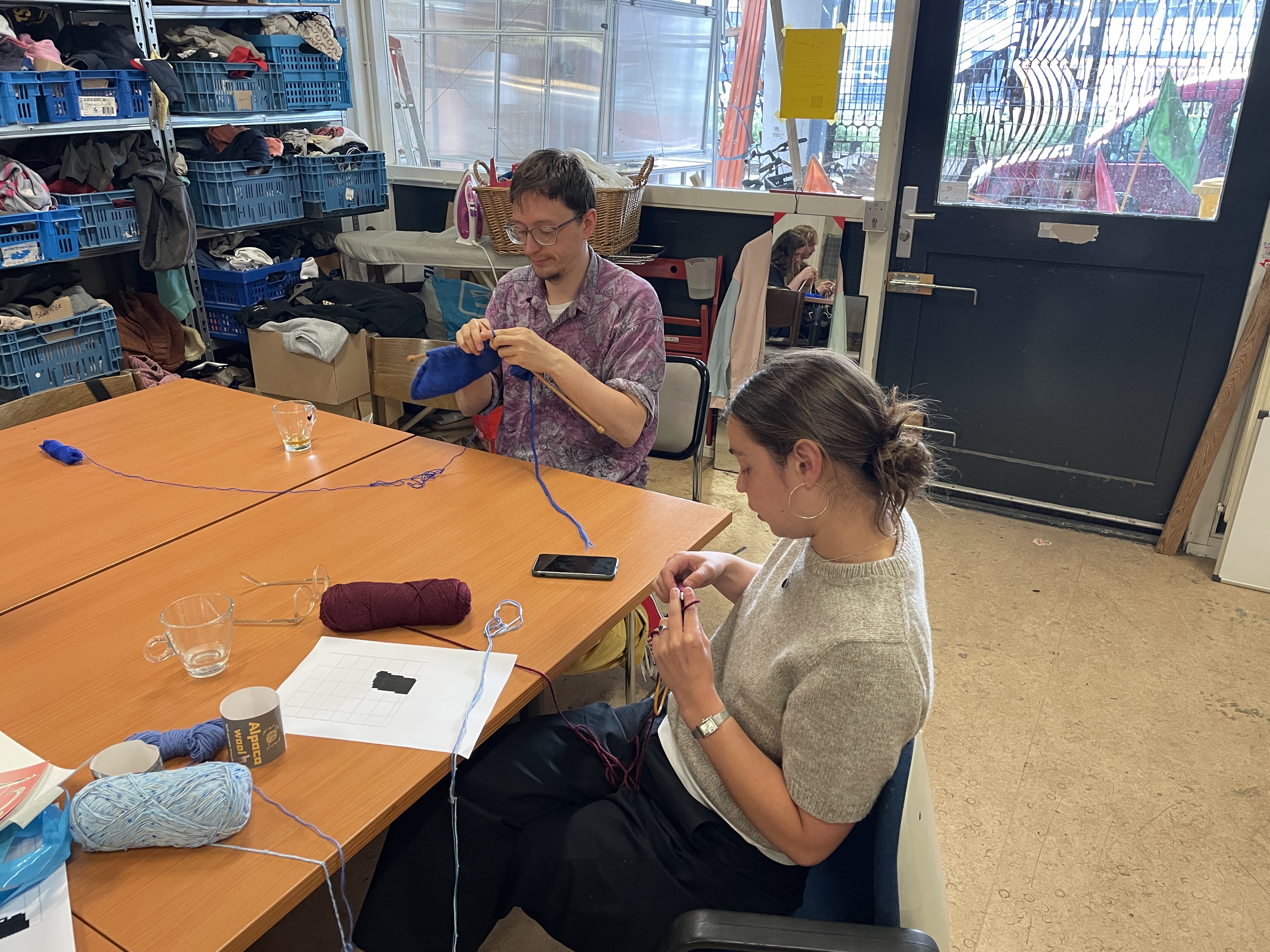
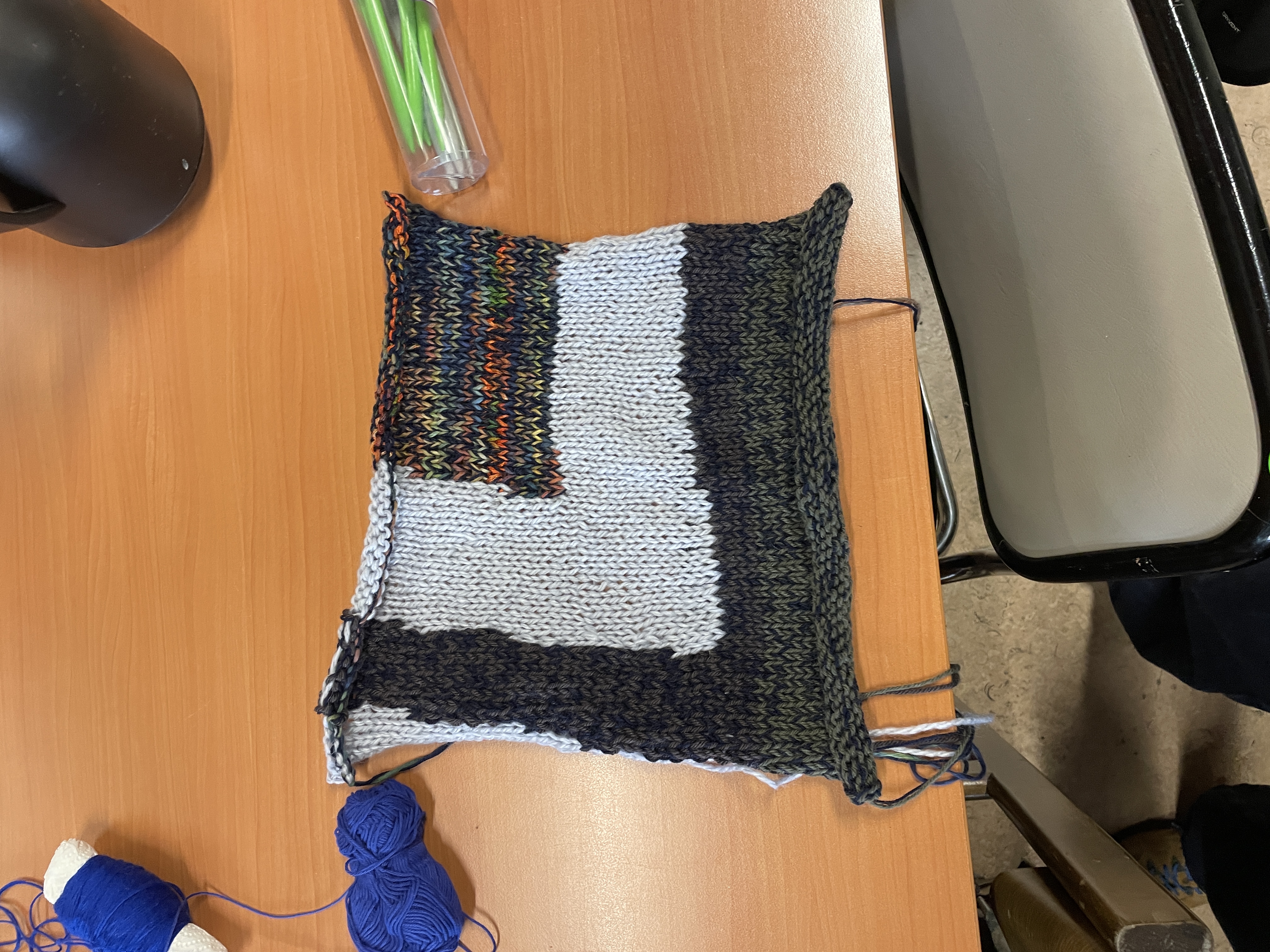
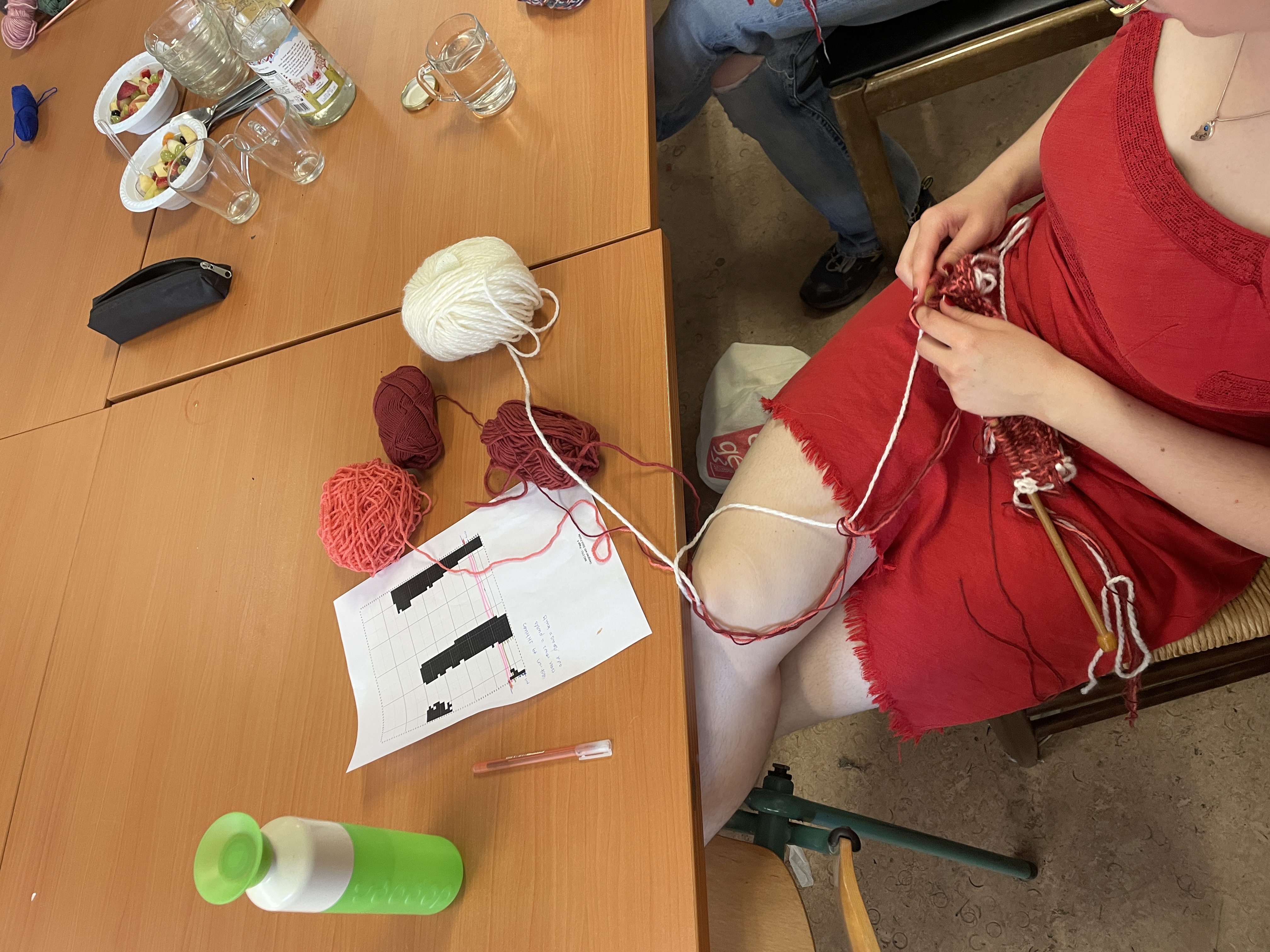
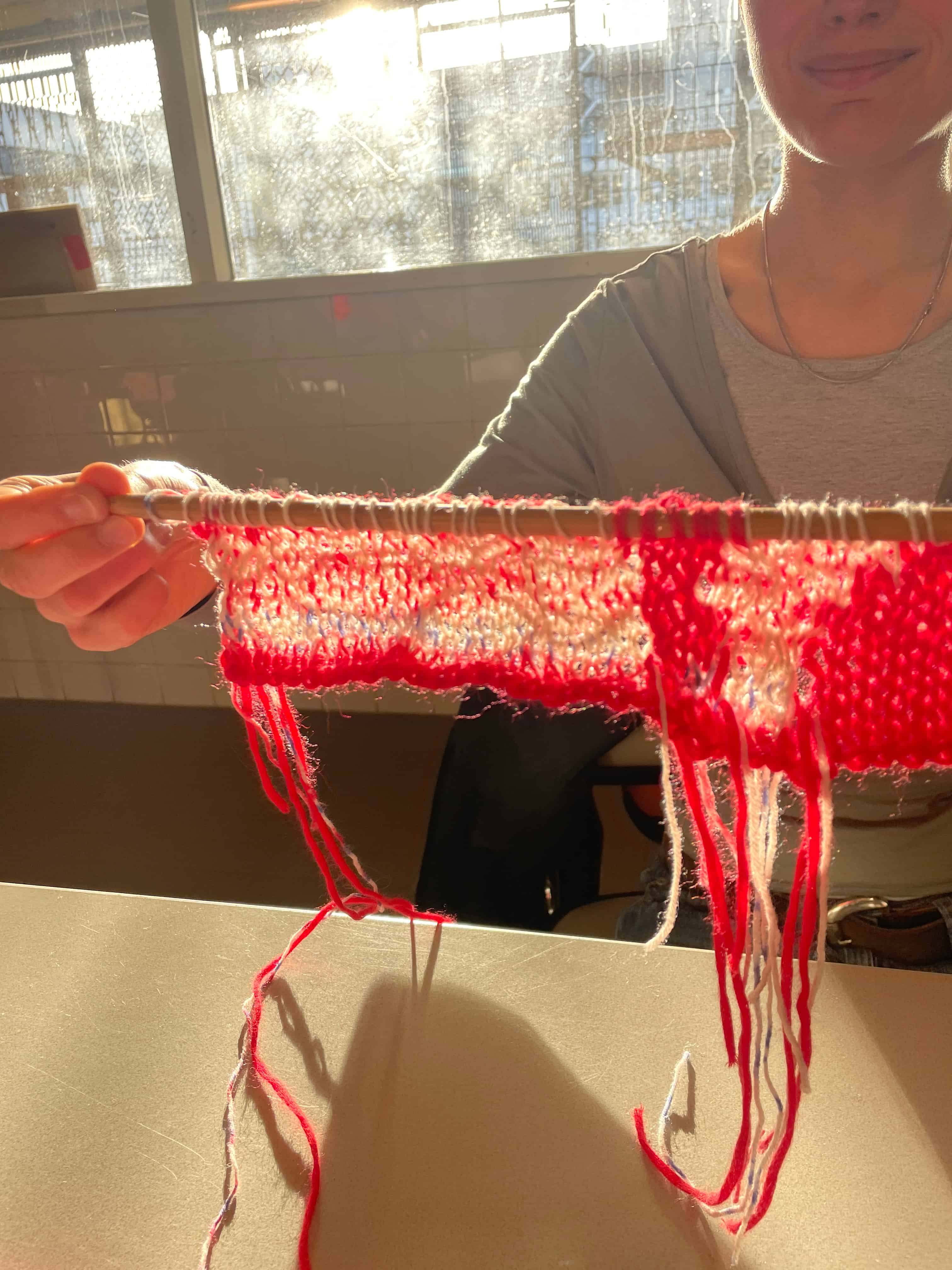
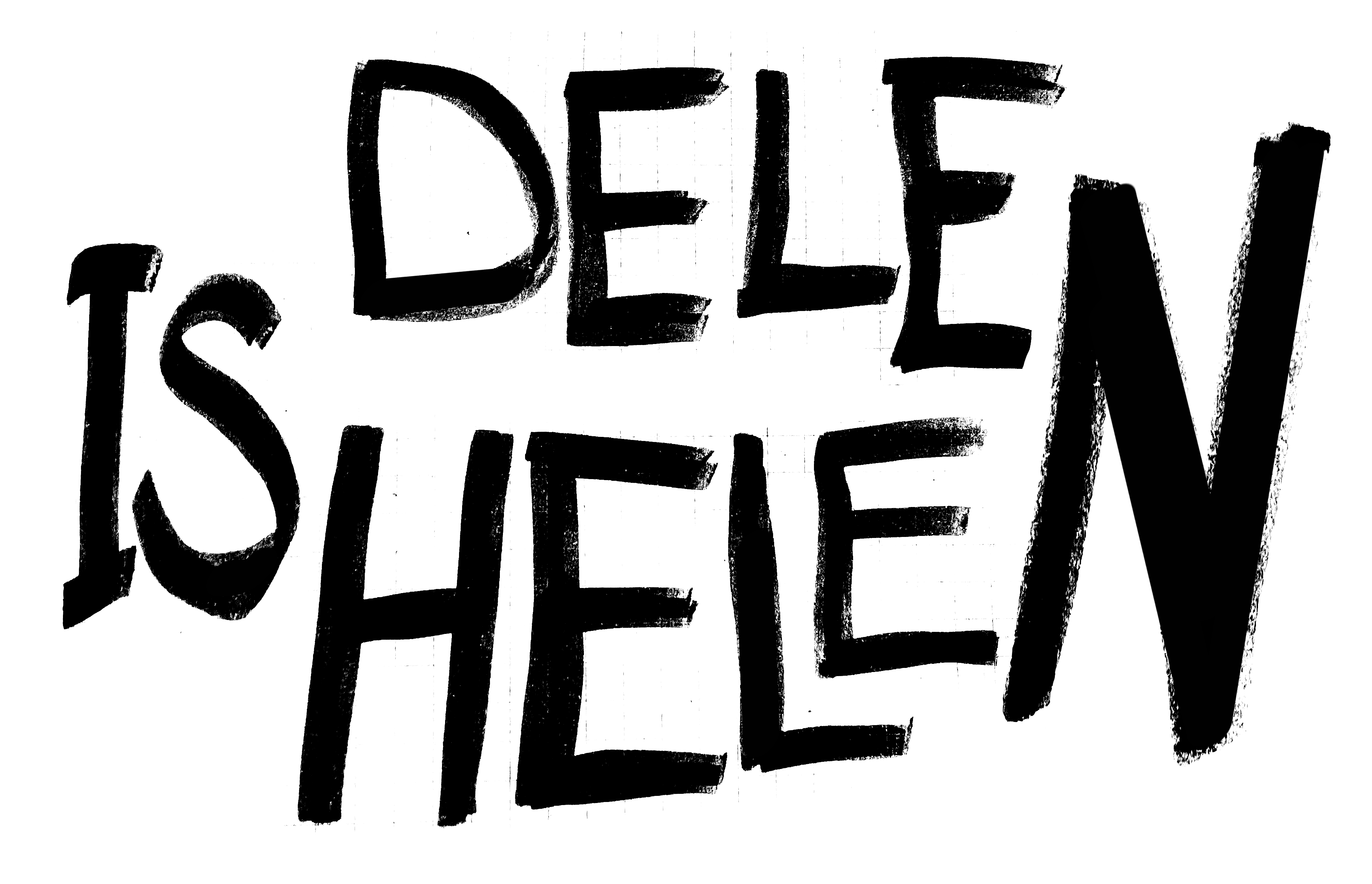
In close collaboration with Agnes Circulaire Maakplaats, I started building a plan for a serie of knitting workshop that would bring people together to work on a common goal, which is a space-specific tapestry. In this specific case, the design borrows the space's slogan Delen is Helen, sharing is healing.
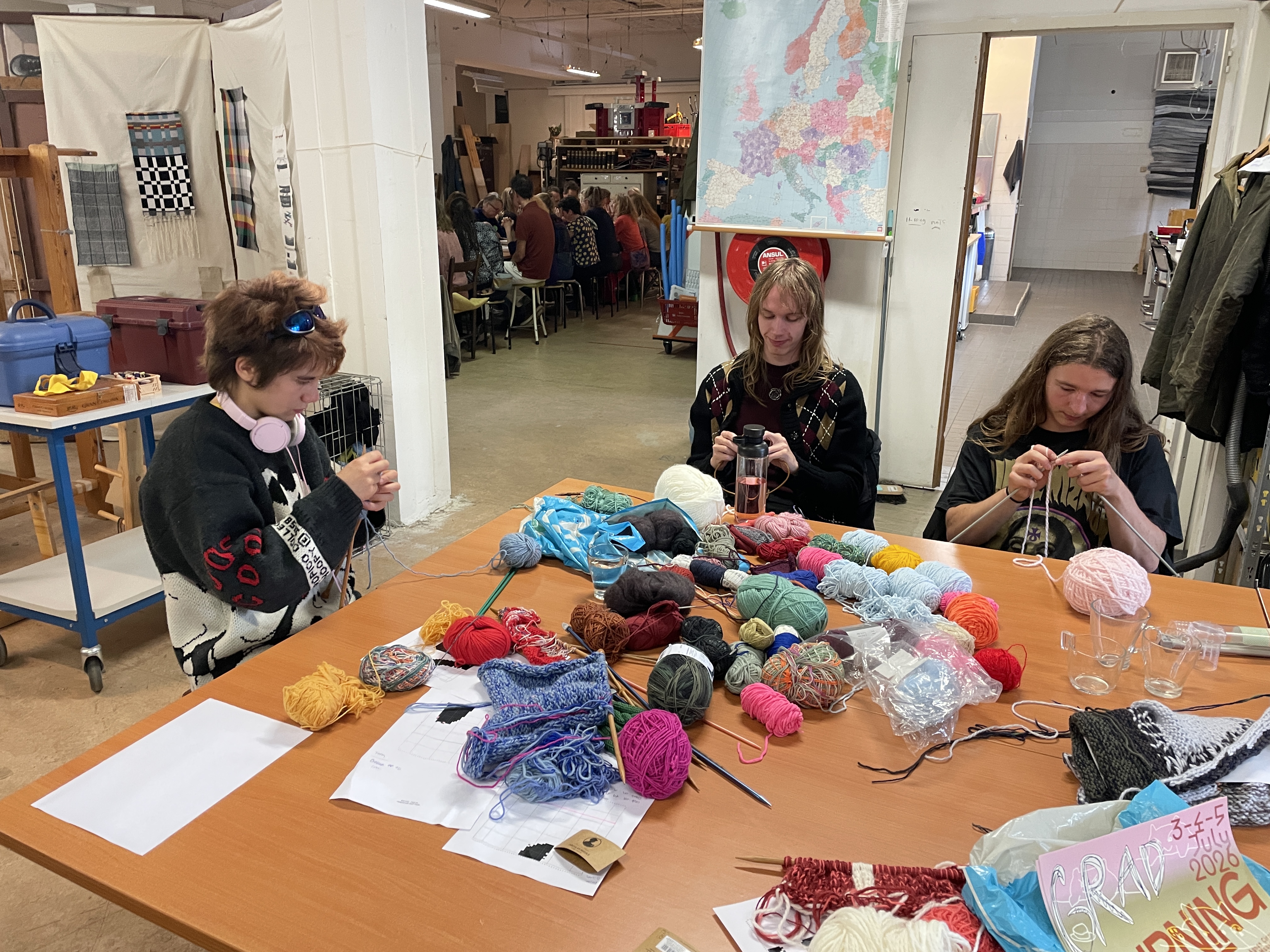
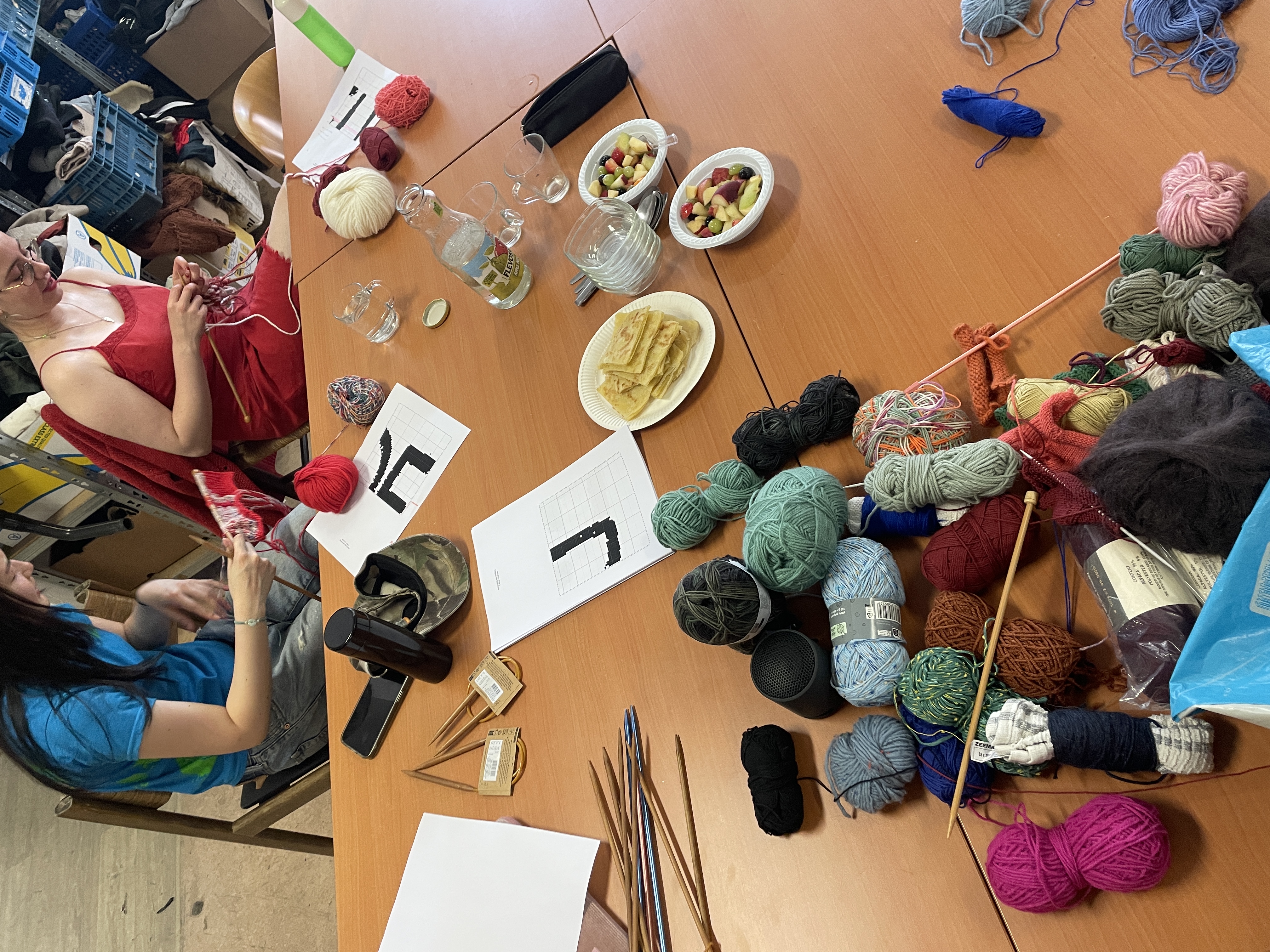
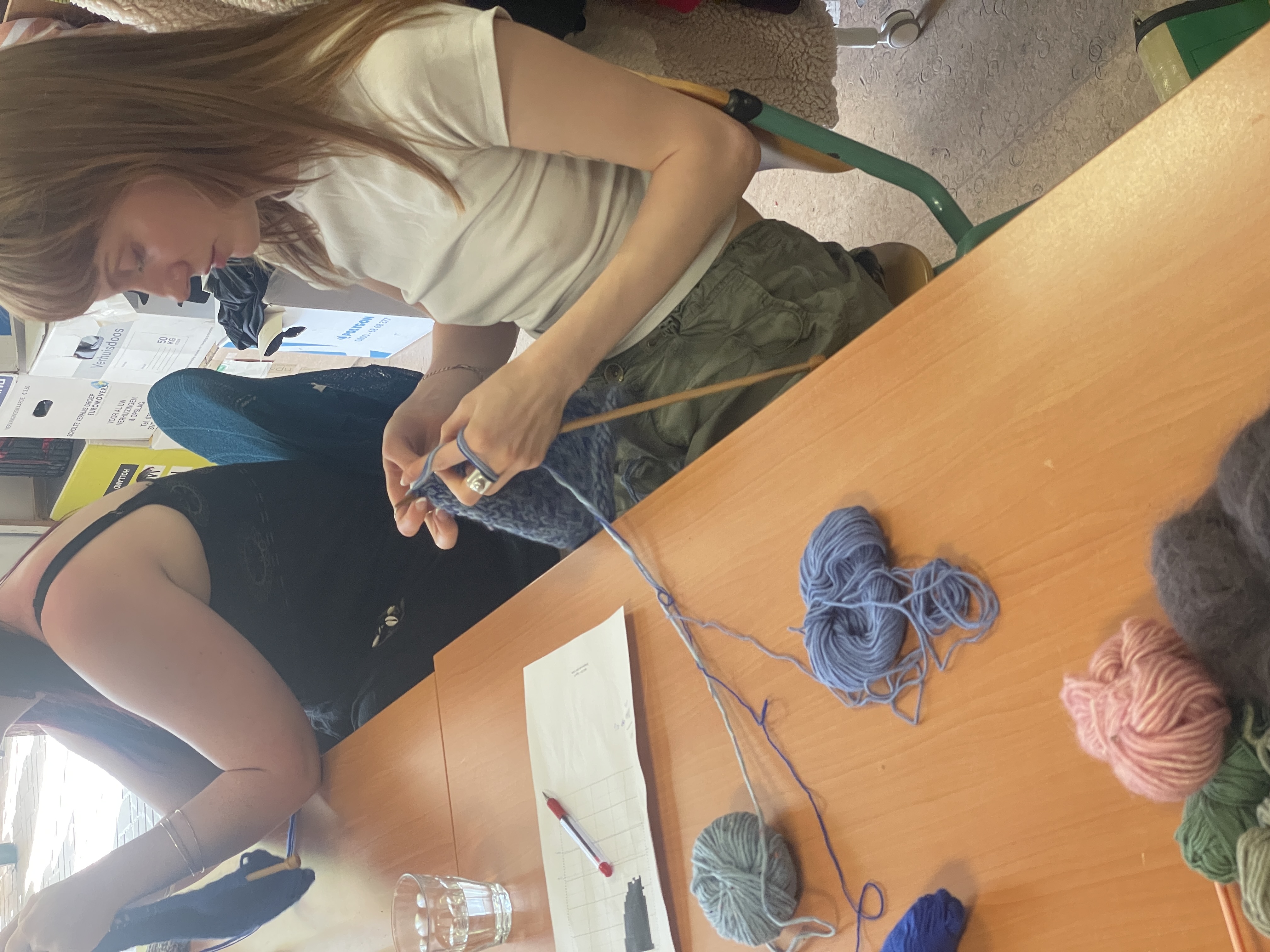
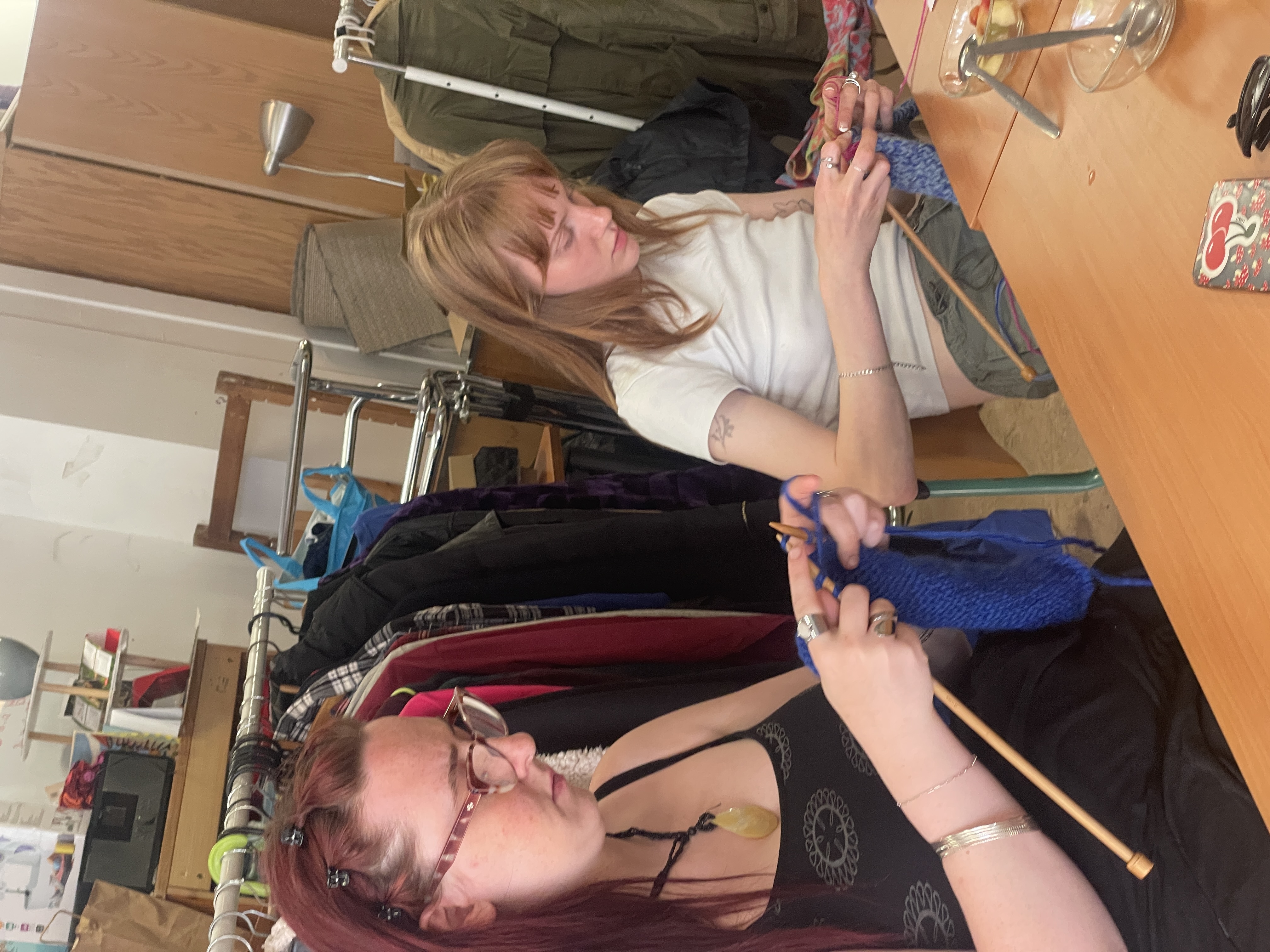
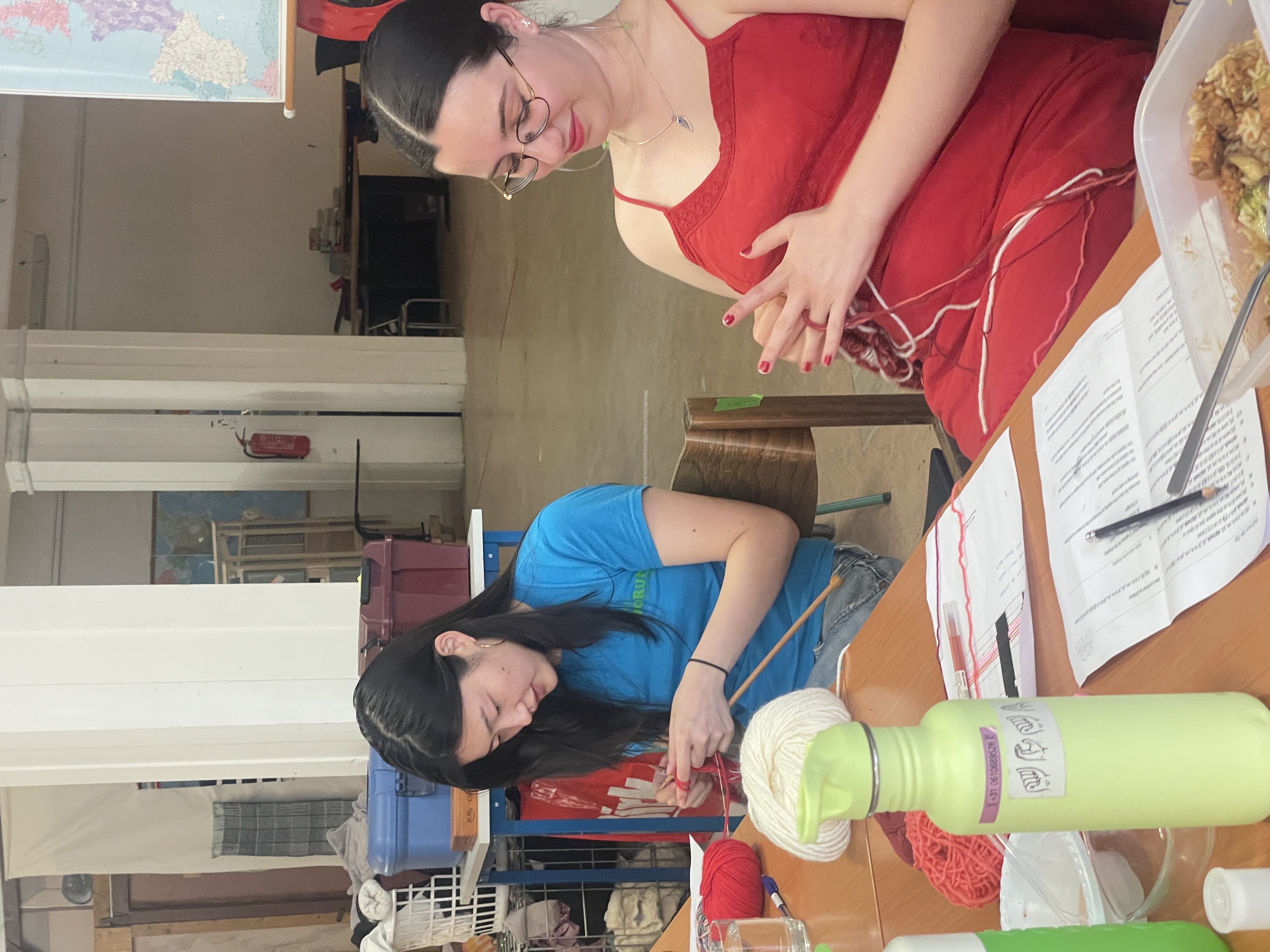
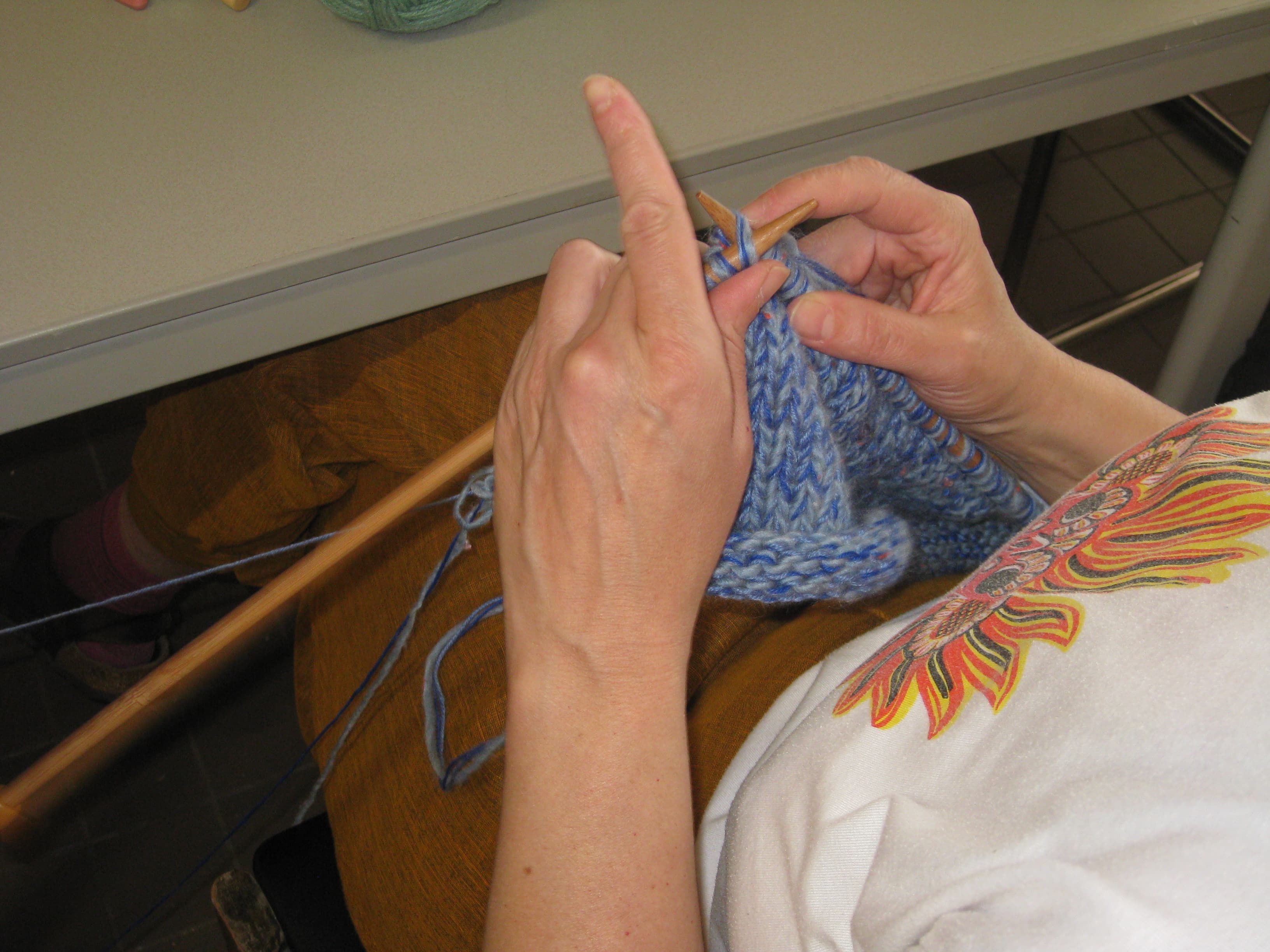
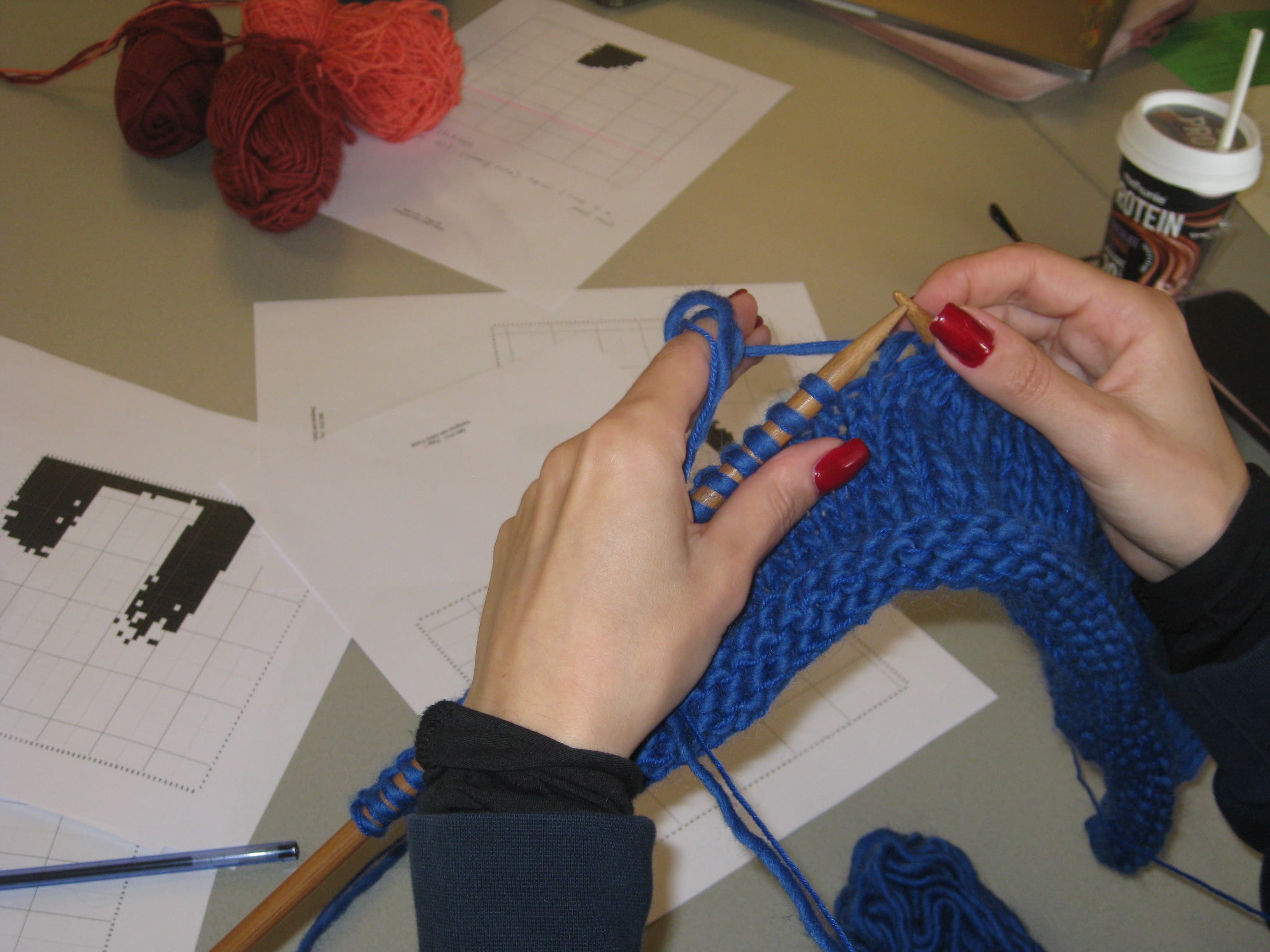
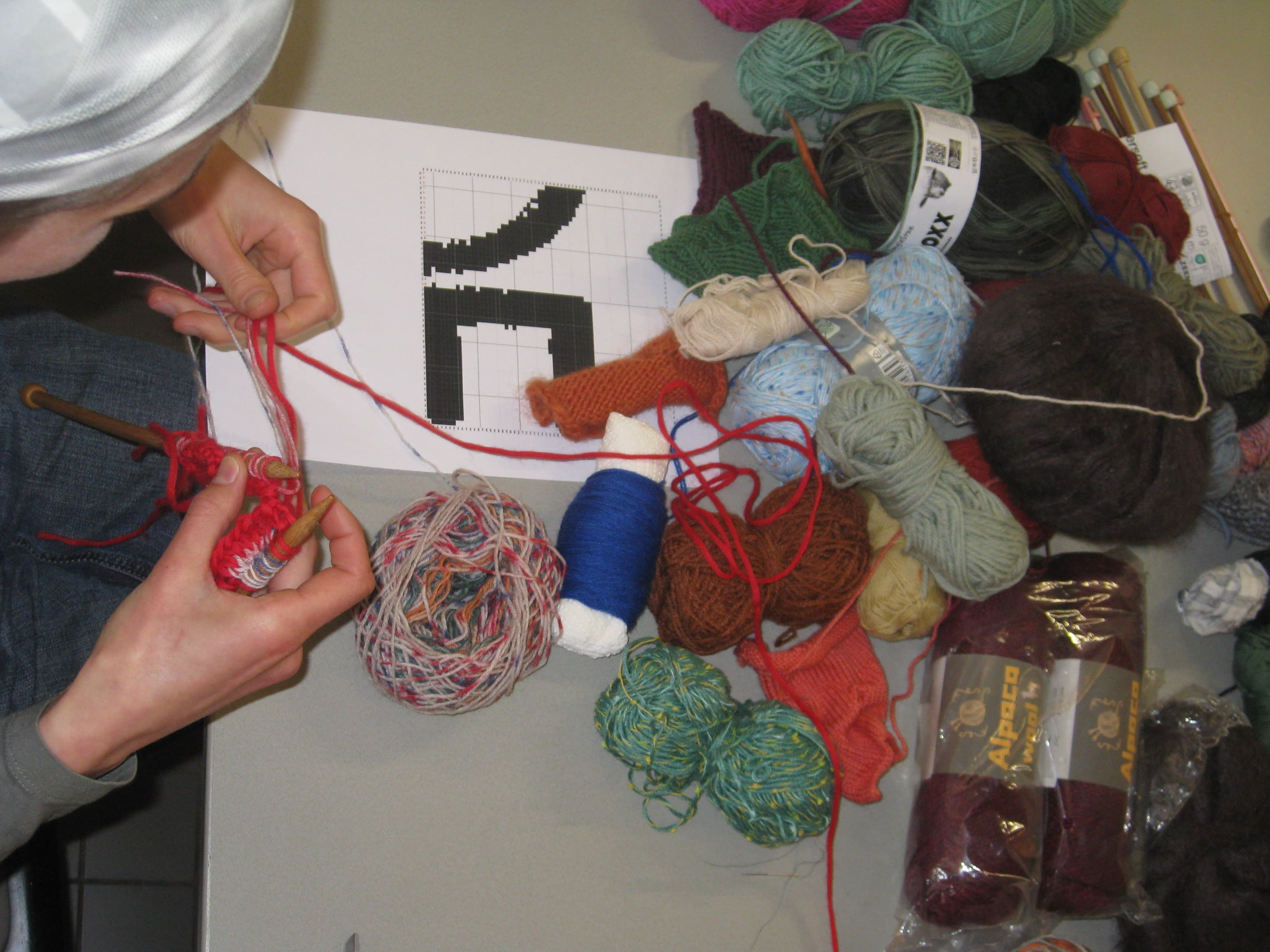
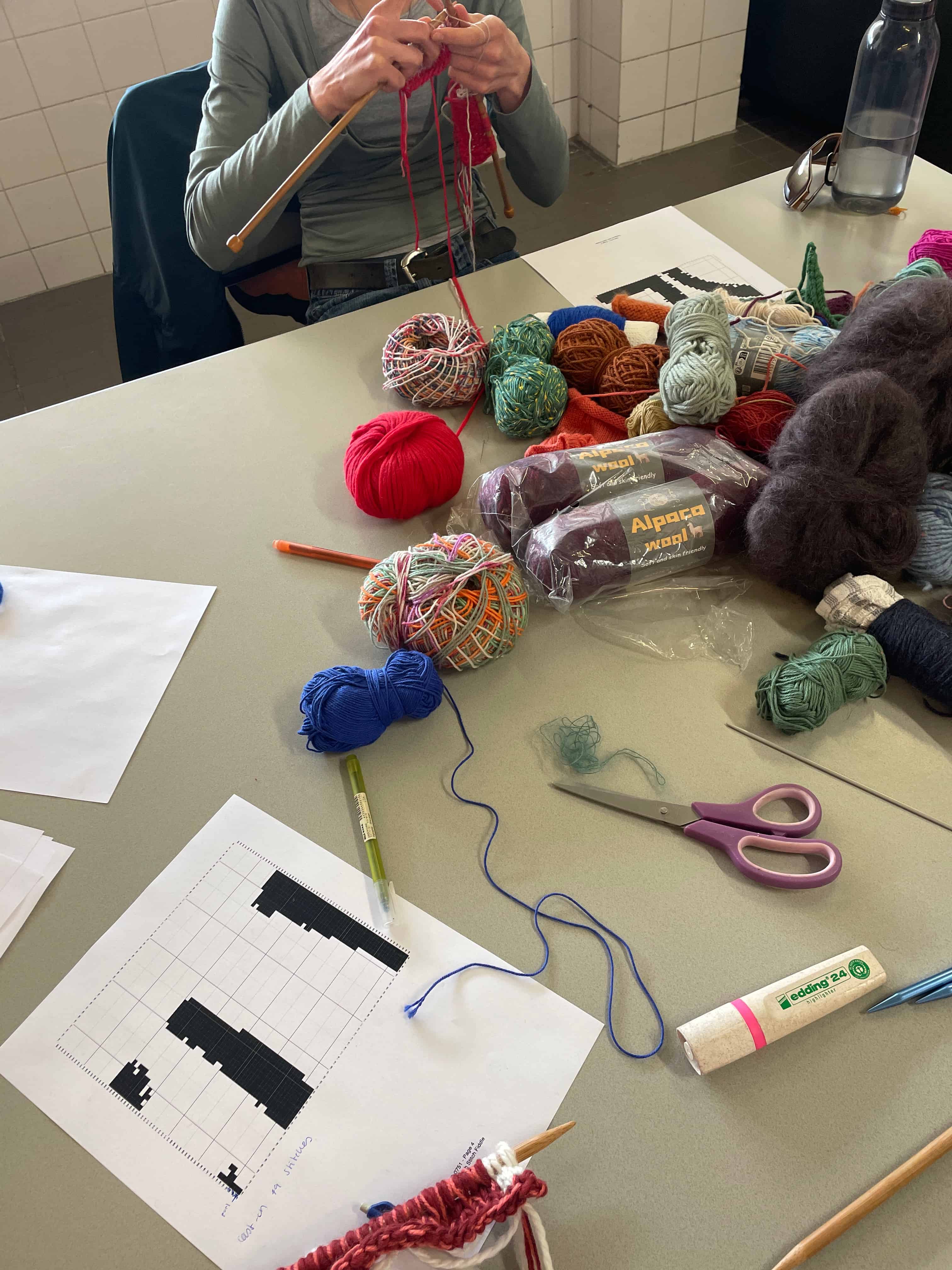
From May to July 2026, we have been meeting weekly to spend time in a anti-productive practice, nurturing healthy conversations around craft, time, fibers, personal affect, and so much more. We also had the opportunity to write about it in the project log section of this website.
The workshops are held weekly at
Agnes Circulaire Maakplaats. They are completely free and open to beginners. Every
Thursdays at 18h00, join us for a moment of commuknitty, working together
on a revendicative tapestry that will soon be part of the space it's
being knitted in.
You are most welcomed to join and let us know by sending us a quick
email. Don't worry, there will be space for you even if you don't!
More workshop dates will be announced for September and October as we are currently working on a schedule with AGNES. If you want to ne notify when the dates are released, you can do it by sending me a quick email here!
See the past workshop results in the Project Log section.
Log is yet to come, images will also be updated soon!
Present during the workshop: Tessa and the public
Sadly, due to the heatwave that hit Europe during the week of 22nd to 28th of June, we decided to cancel this workshop, as we deemed it unsafe to have people go out in the heat.
Present during the workshop: The Sun The Heat Not Tessa
▶ I worked on an existing swatch. I am a beginner, and I struggled with accepting the flaws I introduced to the piece. In the end, I unravelled my work because I felt it was too deficient. I find it hard to let go of my perfectionism. I talked briefly about computer programming and the overlooked efforts women took in pioneering the field. Overall, I had a good time!
▶ Hello! I am Karin, today a was at Agnes for the Commuknitting project. We talked about making things and working together like this. My question was : is this a kind of economy ? or has it nothing to do with it at all? with Micha i spoke about the economy of inspiration. That is a new idea for me which i take home with me as a Nomadic thinker and do-er. succes for you all !
▶ It's only now that I am reading the participants' log that I realise that Raquel decided to unravel her work. I sadly didn't notice at the time, but the conversation we had previous to that revolved around this concept of mistakes in crafts goods. Old english folks tales say that one should always leave a mistake in a knitting project to ensure not to trap your soul in it. In other variations, you sould always make sure that you knit at least one hair of yours in your project to protect yourself from bad spirits. We then drifted to the origins of computing, how the first informatic bug was an actual insect bug, and the way women have been erased from informatic history. Parallel to that, I was keeping a curious ear to Karin and Misha's conversation. Most of it happened in Dutch, but reading Karin's log, I'm realising I understood way more than I thought, which is a personal success. Without directly taking part in the conversation, I want to answer that yes, workshops are somehow a type of economy, or at least, an economy of time. Because any time spent somewhere adds value to the task you were completing during that time. Maybe the value is in a wage, and maybe it is a tangible object.
Present during the workshop: Raquel Misha Karin Tessa
Unfortunate day to hold a workshop when it starts storming and pouring 20min before it begins! Sadly for this session no one showed-up (even the people who had signed up through email), and Misha (who is usually present to open the space) and I ended up doing absolutely no knitting. However, he taught me how to use a drop spindle and even helped me spin a bit of yarn. This was a totally new experience for me, but one I had been wanting to try for a while without really knowing where to start.
It's also a perferct opportunity to mention that I would like to explore more aspect of the fiber arts crafts, such as dying, spinning and weaving. While I still haven't managed to go to one of Misha's workshop, he mentionned multiple times wanting to organise a craftivism month of workshops, and I would be 100% interested in joining as both co-host and participant. So even though very little knitting was done during this session, many things still happened in terms of fiber talk.
Present during the workshop: Misha Tessa
▶ Hello!! I am Mort and this work shop was very lovely, I intend on coming back to further develop my knitting skills, but above all contribute to the EPIC WALL CLOTH. I think that would be really great if finished and I want to parttake in something bigger than myself. I've also very much enjoyed the social aspect of it since I've now also been invited to a pirate stitching event which sound awesome!! This is exactly what i was hoping for because I want to feel like I am doing something with my life, meet new people and make memories. THANK YOU FOR ORGANIZING THIS, MAKES LIFE WORTH LIVING
▶ Hi, i'm Filip, it was really fun learning how to knit, there was an amazing atmosphere and teaching, Would recommend!!!
▶ This was only my 2nd communal knitting experience – I have always treated knitting as a bit of a private activity, but it turns out knitting with other people is great. We talked about loads of different things, from knitting reality TV to our favourite fibers to our life plans. Always interesting to hear about other people's relationships and habits when it comes to crafts.
▶I enjoyed learning about knitting: purls and knitting stitches! It was also good to socialize and make something together. It is always great to make something with a group, because it makes you feel like you are part of something larger than yourself.
▶ I had a great time at the workshop. At first I took just focused a bit on learning the basics of knitting and practicing for a bit. After a bit I got the hang of it and just ended up chatting with some of the others.
Pretty soon the motions came automatically. I discovered one of the others was a organiser for a small venue in Delft I wanted to visit for a while and the other person plays in a band which was going to play there soon. We also discovered we went to the same small concert a while ago.
We spend the rest of the evening just knitting and talking, telling eachother fun anecdotes and talking about other cool places and events.
I mainly just liked the contrast with my job. This week had been a very busy week. I work as a software developer, and this week I had a support shift, meaning that I had to handle all incoming mails with questions and issues with from our customers.
This usually means you are constantly solving one issue after the other, determining which issues have priority, and trying to work down all of the issues.
After such a week constantly focusing on finishing these issues, it was great to just do something for fun, without any push to be productive or make something flawless.
It was nice to just sit down, have something to do, and have some people to chat with.
▶ This was probably the first workshop during which I was somehow frustrated. I've had a very intense and long week previous to that one, and I came to AGNES already grumpy. I spent a majoriry of my time there teaching the basics to Mort, Filip and Julie, and as a result, had less opportunity to engage in more craft conversations. But I realise now that I'm writing this log that this might've been exactly what I needed: extract myself from the Big Conversation and focus back on the basics, the movement and the material. Reading the workshop participants' personal log made me realise maybe I should also ease myself into the workshops too, and not try to see and control everything that happen during them.
Present during the workshop: Mort Filip Helena Misha Julie Tessa
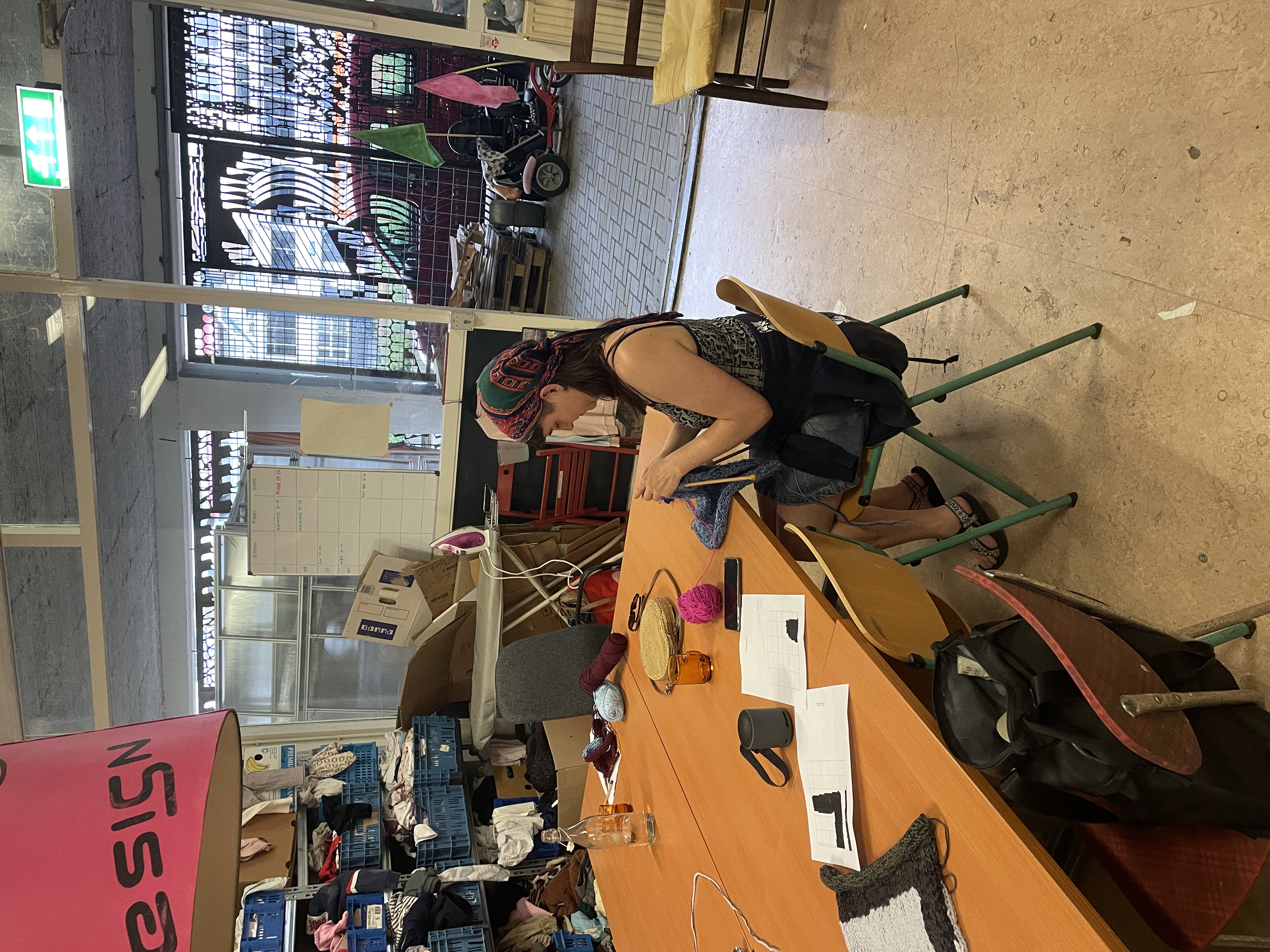
This week's workshop was a pleasant surprise, as more people kept showing up. From last week's 4, we were 7 this time, which I think is a sweet spot for me. It gives me enough space to help beginners or to show people some techniques, and it also allows for a fluid conversation to happen around me.
Some of the topics of this week were hobbies, and how hard it was to define what a hobby is. Can you define yourself through your hobby? More than your job? How do you navigate having multiple hobbies? Karen for instance explained how for her, hobbies just happen when she's interested in something, as she is somehow driven by a "How hard could it be?" mindset (and it is something I completely agree with). Someone once asked her to DJ for an event, and she just decided to learn the basic skills required for that, and it apparently was a success!
We also talked about how taking up new hobbies as an adult is a way to let yourself be a beginner again. In a society driven by efficiency, excellence and hustle mindset, knitting allows for a break, a moment during which we know we cannot go faster than what our hands do.
We also mentioned the origins of programming and how textile making machines were the actual first computers. I recommended reading Sadie Plant's *Zeros + Ones* to dive deeper into the origins of early computing machinery. And so came the topic of bugs and mistakes, which fed back into making mistakes when learning how to knit. Imer, who learned how to knit on that day – and did a damn good job considering she's left handed and was taught by a right-handed person – had very few visible mistakes, and even with them, I explained how that was valuable to project. Indeed, the aim of the Commuknitting workshops are not necessarily to teach perfect technique or to produce a perfect piece of textile, but more so to spend time together, building community, and focus on the process rather than the outcome. Outcome will happen eventually, but it's not what I'm interested in.
Present during the workshop: Nienke Marlene Imer Jules Karen Dari (shortly) Tessa
During this session, I re-introduced the project to the newcomers, explaining the root from the thesis and the history of knitting as a slow craft and pulled a parallel with how fast paced the world feels nowadays.
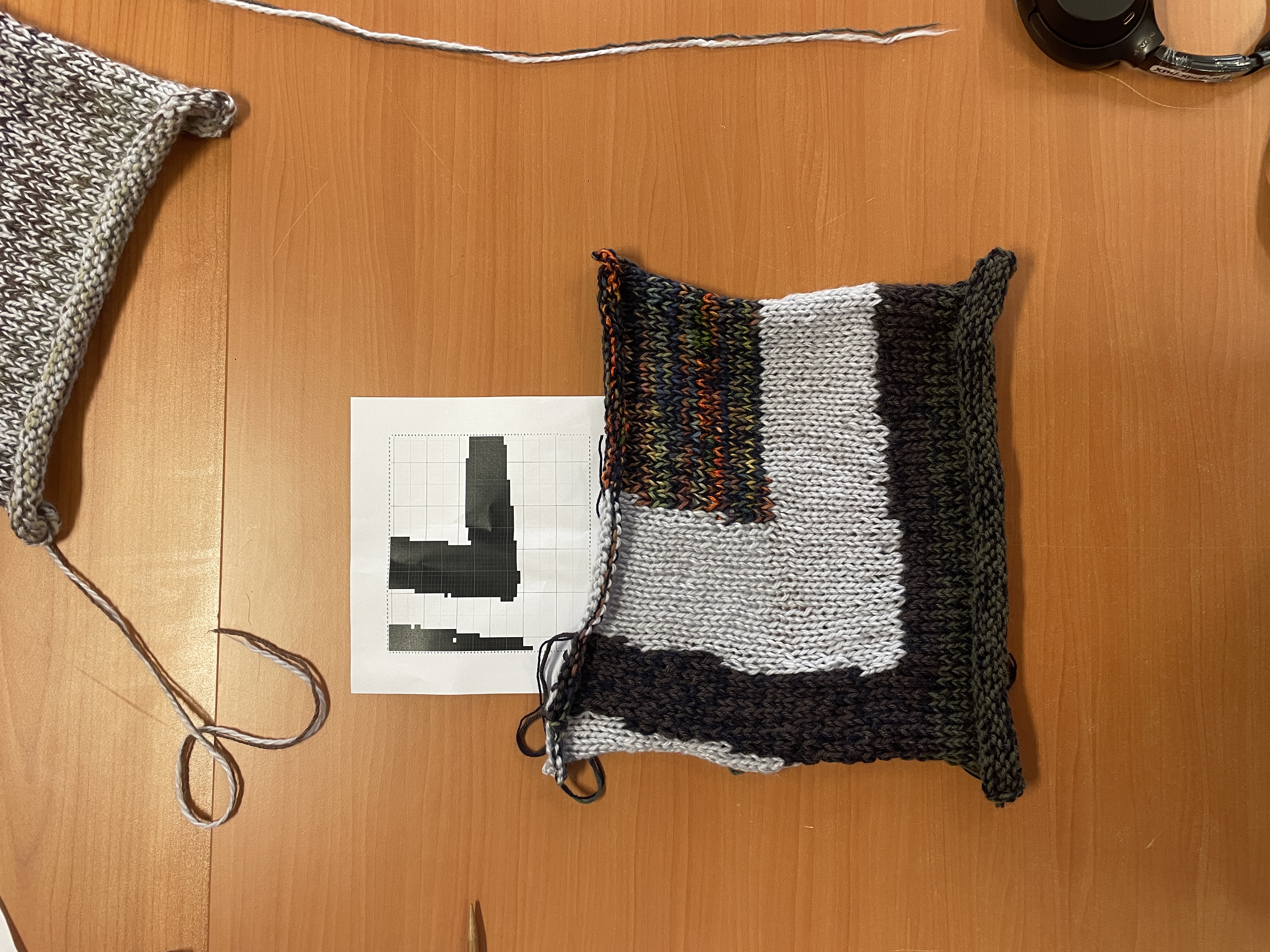
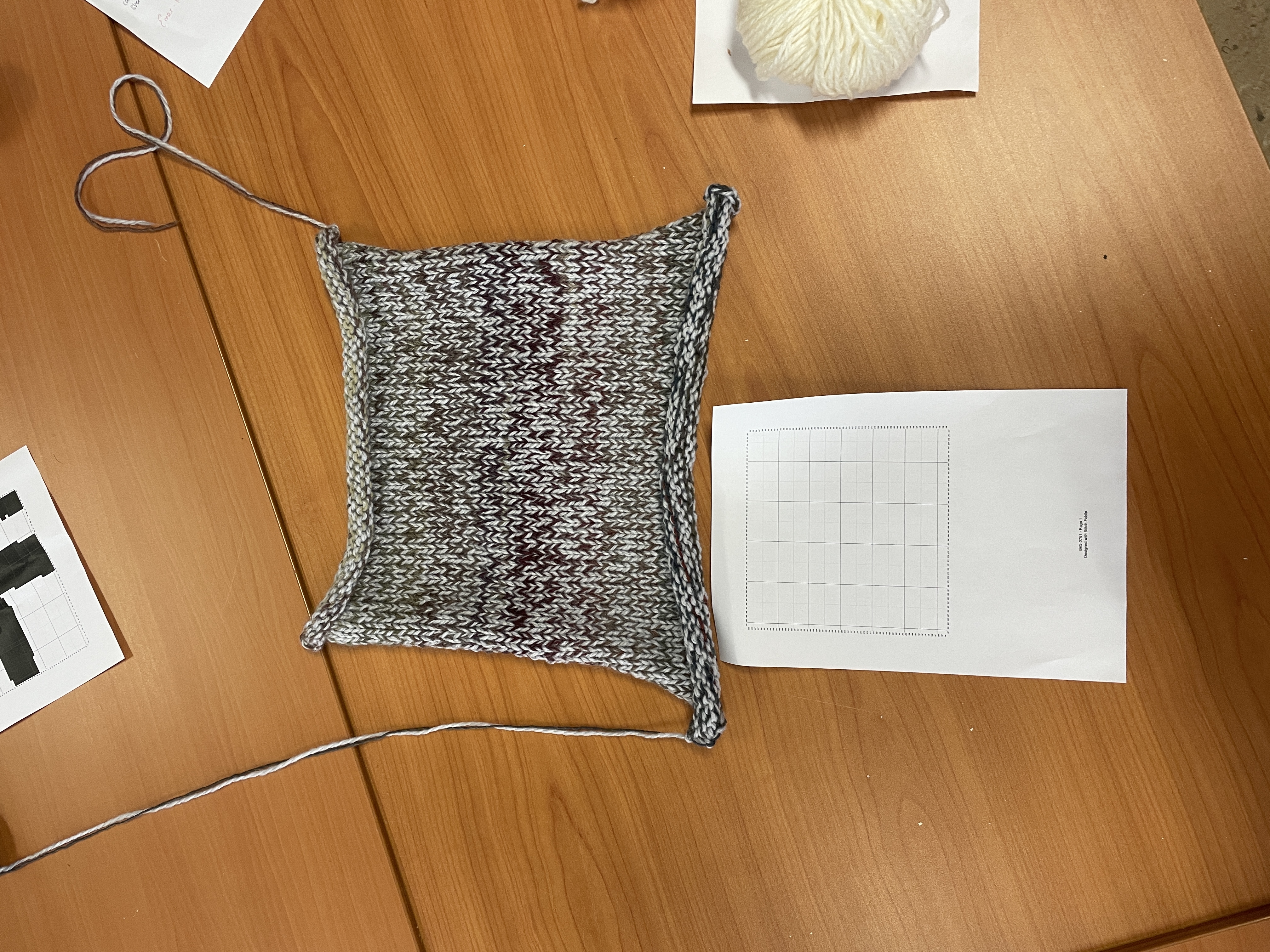
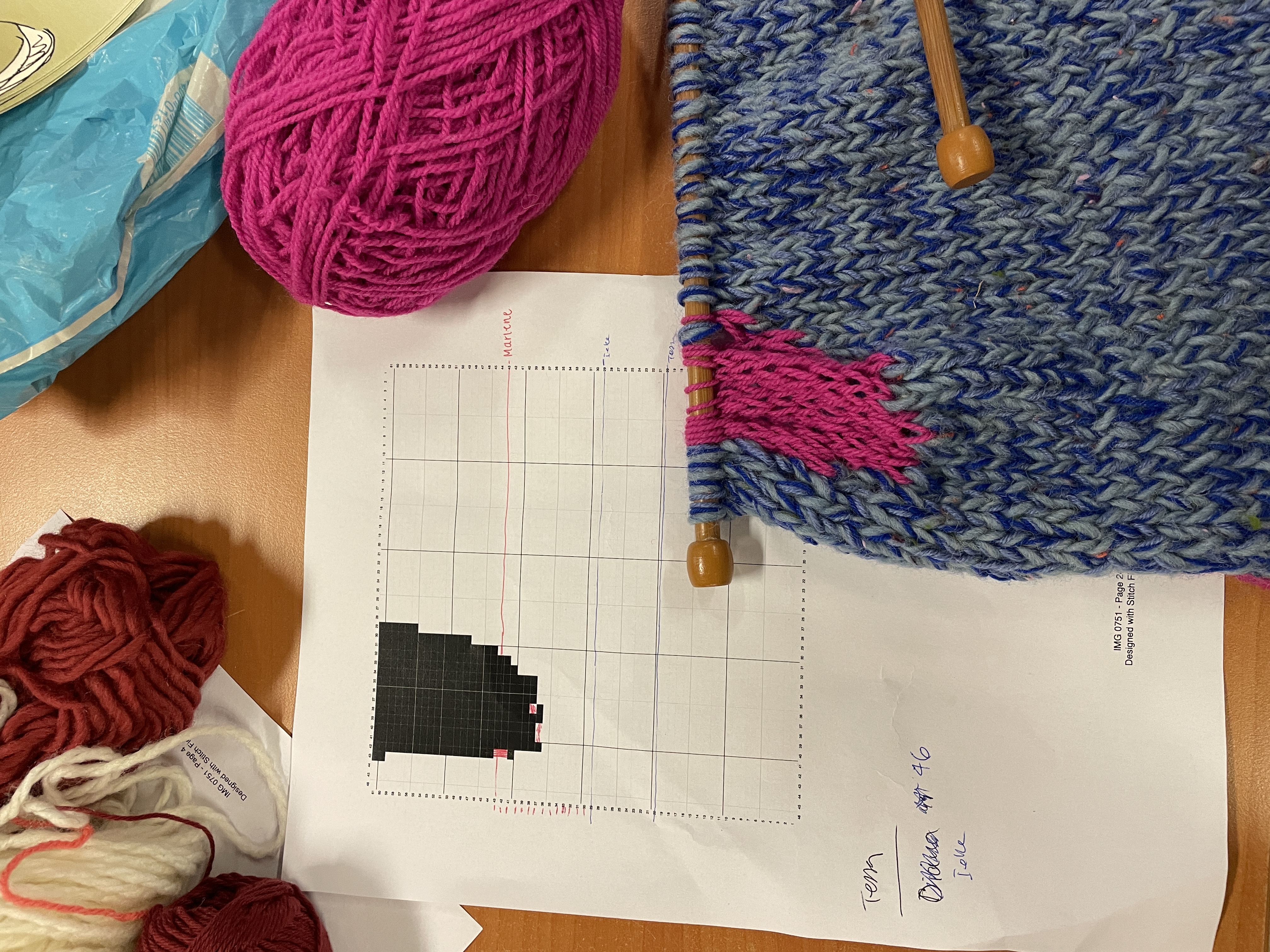
Two of the three people present had less experience knitting, so I showed them different ways of knitting and purling to find the most comfortable way for them to get it. One of them ended up going with the Portuguese techniques, as it was the way she had learned from her mother a few years ago. She took over Misha's section from the previous week. The other one took a few minutes to get back into the muscle memory of the craft, and then it all went smoothly for her. She might be twisting her purls or knits, because there's a visible change in texture between the portion I worked on last week, and her current work. At first she looked worried about it, but I assured that was actually exactly the kind of bumps I was looking for in elaborating this project: the fact that even following the same pattern, and working in the same space, individuality transpires.
Kim also started immediately working on a colourwork section, which is very impressive. Along the way, we decided to introduce the notions of catching floats behind her work to ensure an neater finish. Their choice of yarns made it visible from the right side of the fabric, which I personally love; how magical is it to see the inner structure of what you're working on?
Present during the workshop:
Kim
Ieke
Diana
Tessa
This first workshop only had one participant and me, which was a bit scary at first, but it ended up becoming a sweet opportunity to have a heartfelt conversation. We covered the topics of The Game Of Wool TV show and how unsatisfied we were with it as viewers. The time and efficiency aspect of the competition and the inadequacy of the challenges were our main complaints. We also talked about the differences in weaving and knitting as techniques, and how one was industrialised and one was not. This brought us to analyse how being a male or female in the textile art field could be stereotyping in both situations. Our point was that textile and fiber arts have been historically dominated by women, but never recognised as worthy of beeing seen as art. Introducing a man artist in that field would give him the opportunity to invoke the common artefact of the Male Genius, alienating him from the craft history of fiber arts.
We worked on two panels of the tapestry, making little progress, but enjoying the slow process of it all. The two hours flew by, and we were both baffled by how quick time passed!
Present during the workshop: Misha Tessa
When you look at a knitting pattern though, you realise that knitting is like a script, as they are a way of describing how to build a complex 3D garment using only a few lines of text. Some are very straight forward and technical and assume you know all the basics already, and some are more conversational and explain all the steps. You define variables at the top, such as the needle sizes, the type of stitches, the weight of the yarn, and then the process is described under it. (If you want to look at patterns I used in the past, you can find them all here)
Without going into more details for the 101 lesson, we can summarise knitting as a serie of interconnected loops that either turn inside or outside, or Right Side and Wrong Side. Those stitches are called Knits and Purls, but are often abbreviated k and p.
To keep it short, the beginning of computing started with the invention weaving machines and the use of punch cards to store Jacquard Looming patterns, or as some would say, weaving data. These punch cards carry data for a machine to execute, and the data can be summarized as units (the grid elements) either carrying a punched hole or not. Or either presence or absence of a hole.
Or 1 and 0.
In that sense, knitting patterns are essentially binary code, since you can translate 1s and 0s to Knits and Purls, and with that, make extensively intricate patterns.
There is many way of interpreting a knitting pattern, just as there's many way of writing one. A grid chart or punch card can sometimes also mean a change of color every time there's a change of data (a hole), but for this session, we will focus on knits and purls as a way of translating data into a material and tangible object.
In this section, you will be re-directed to youtube tutorials in english to learn the basic steps and movements required to start knitting. In the near future, I hope to provide my own video ressources filmed with workshop participants.
When learning how to knot, you only really require 4 skills:
▶ Casting on your project, which means setting up your stitches on your needles.
▶ Knit stitches, which are Right Side stitches. They are usually the visible side of your fabric and look like little Vs
▶ Purl stitches, the wrong side stitches, usually on the inside of the clothes, and look like little Us or Os.
▶ Bind off, or casting off, which means securing your projects and taking it off the needles so it can actually exist in the real world, and not only as an on-going project.
▶ Specifically for this project, the concept of Intarsia, which is a way to knit with 2 different colors, is super important and useful to know, though not necessary for a beginner's knitting project.
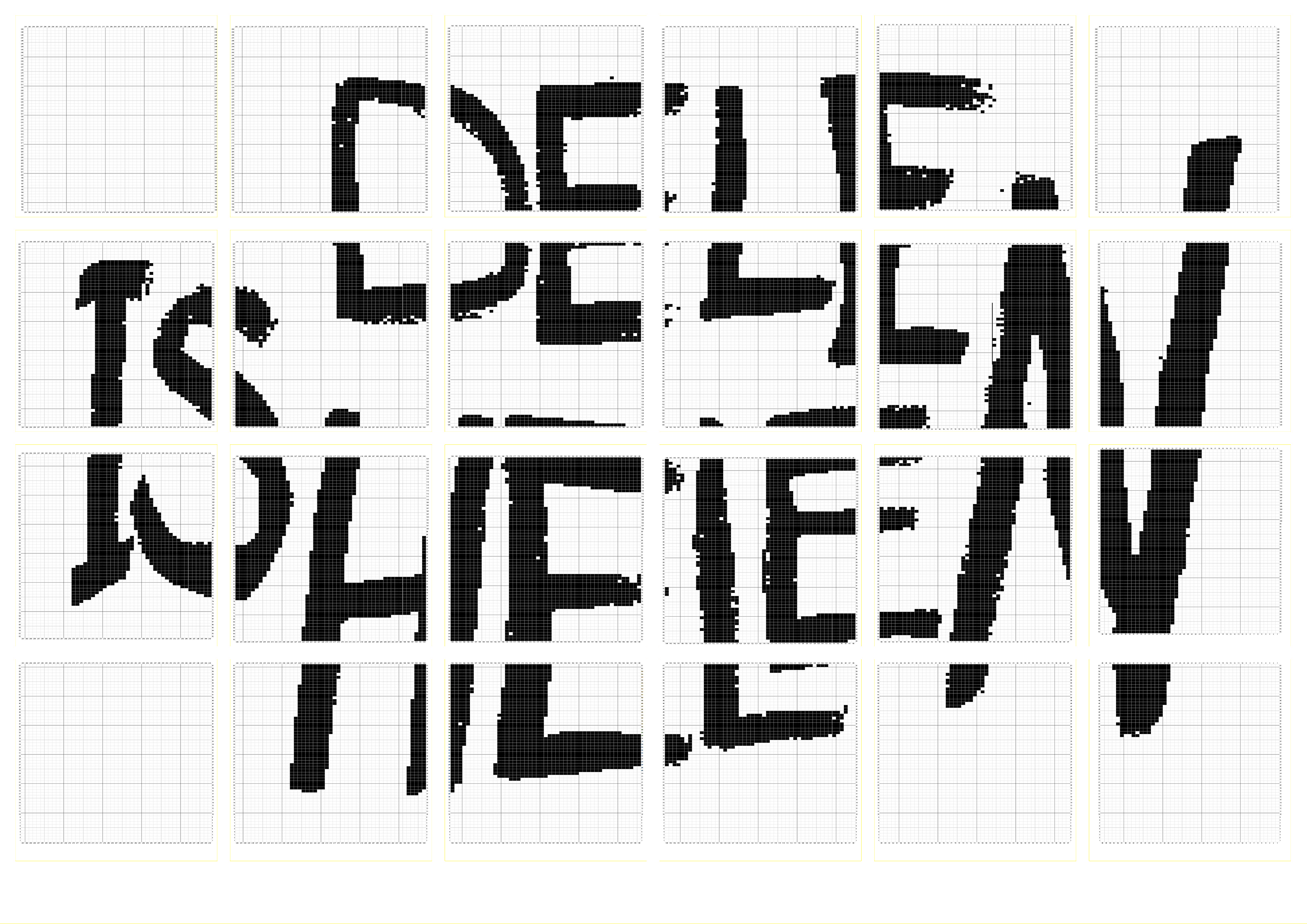
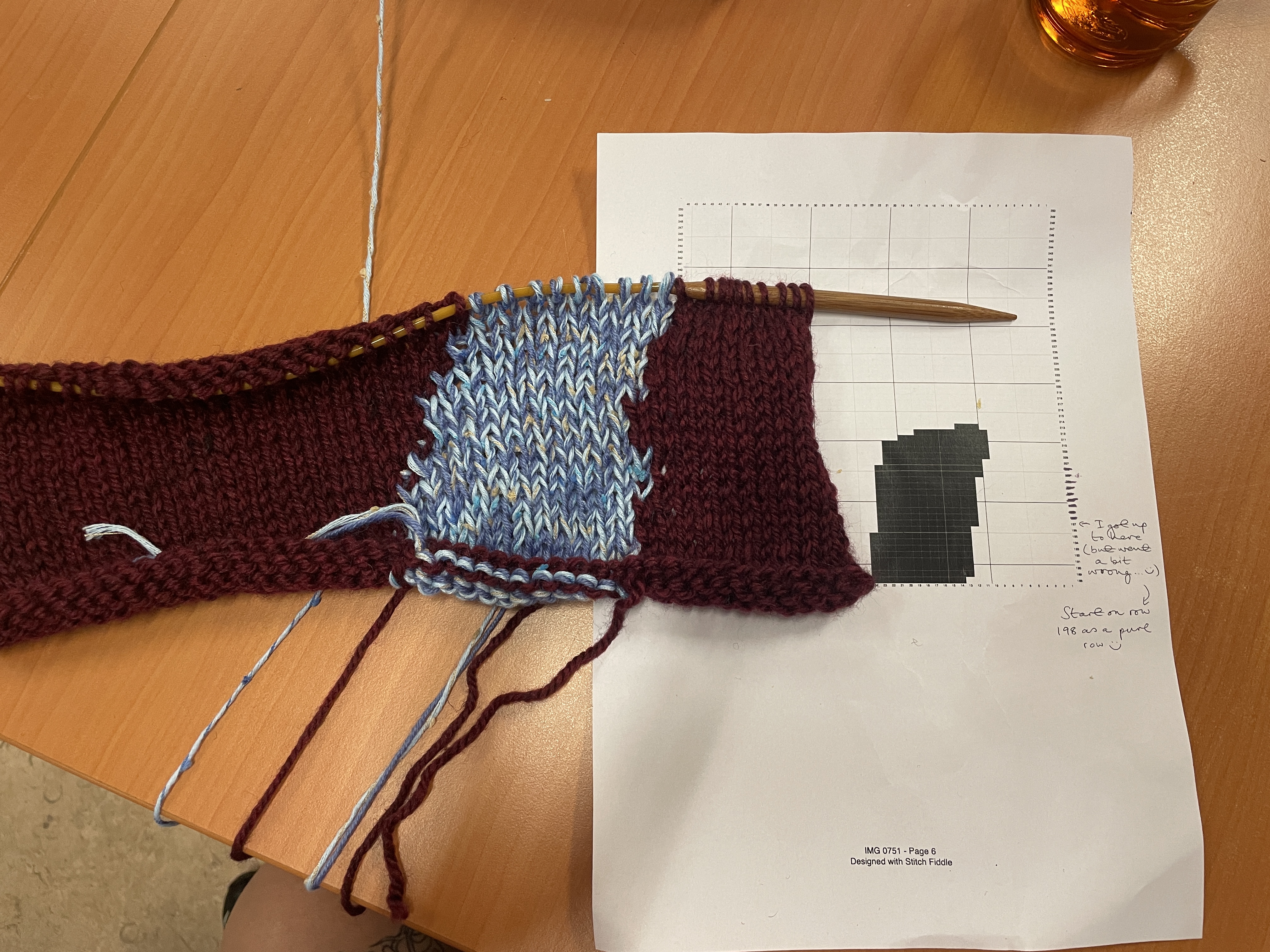
For this project, we used Stitch Fiddle to create the pattern after making the design by hand. Stitch fiddle is a website that can transform any image into a knitting chart (basically, it's pixel art). While it requires an account, the free version is already extremely versatile and perfect to generate new image and color work charts.
If you want to have a closer look at the pattern we've been working with, you can download it by cliking on the image.
During the thesis writing process, one of the thing that csame out from the many interviews I conducted was the (un)sustainability aspect of affordable knitting. While I didn't have enough space to talk about it in the thesis, it's important to me to make a statement here:
Yes, this project uses acrylic yarn.
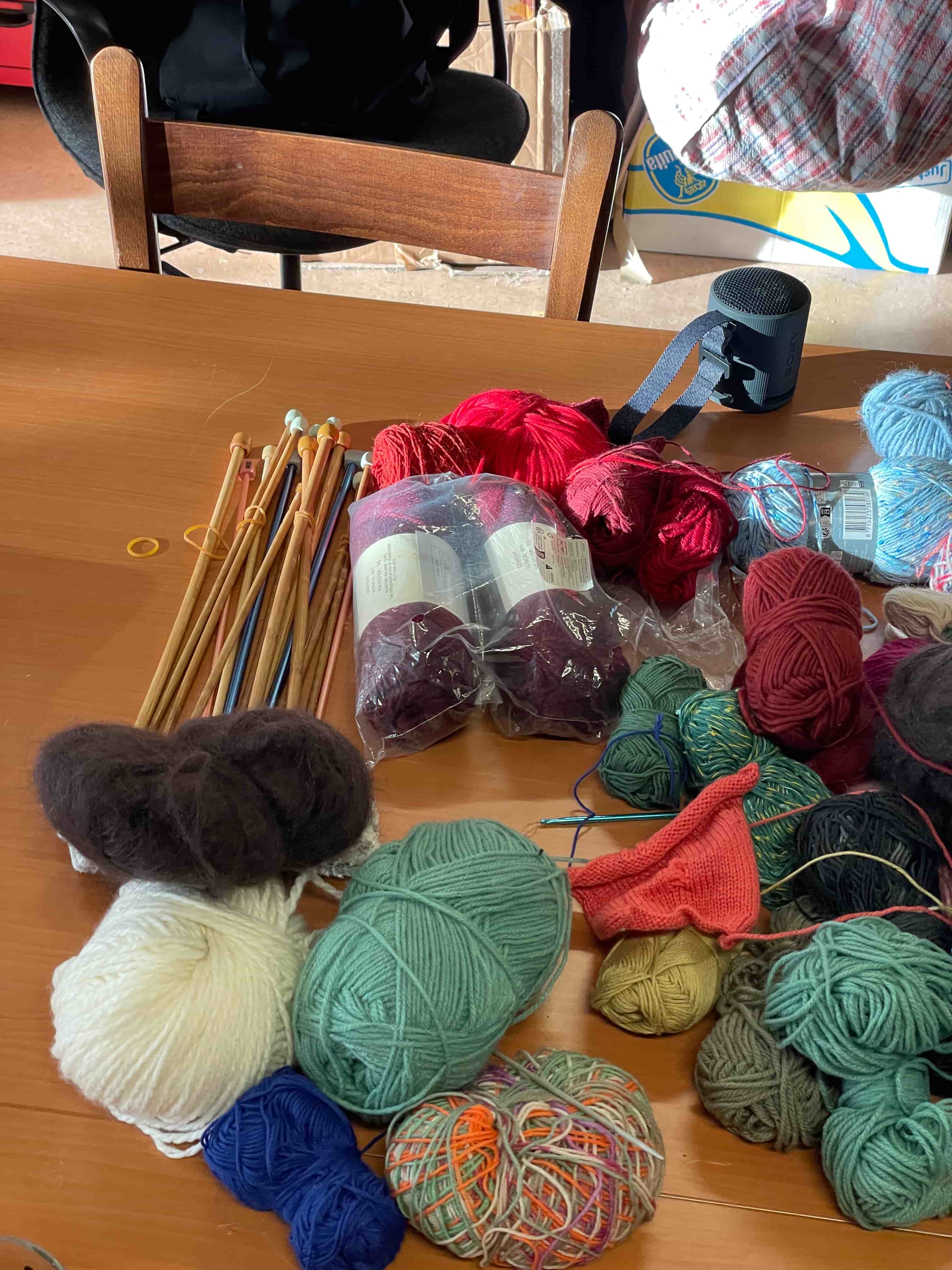
And there's a damn good reason for that. Indeed, we are making a piece for AGNES, whose slogan transaltes to Sharing is Healing, and is directly attached to the Weggefwinkel, a freeshop. The moto of the space it to recycle and reduce over-consumption as much as possible by collecting and redistributing supplies, clothes, furnitures for free. Therefore, old yarn supplies sometimes find their way in their stock, and a lot of these supplies are synthetic fibers.
The great thing about it is that it made for free material for this project. The pther great thing is that we are not knitting clothes, but a wall-hangig tapestry. As such, it will not be washed as often as a piece of clothe, and will not be releasing micro plastics in the water. It will also not stink up from human sweat.
In the end, it works out in our favor. The material is free, it doesn't contribute to hurting the environment, and it gets turned into something social.
This project is on-going and started as a Graduation Project under the
XPUB Master's programme at the Willem de Kooning Academy in 2026.
You can contact me at anytime by
email or on
Signal
. This is my personal contact and not a Signal group, as we decided upon many conversations that it made more sense to have a regular meeting with a fixed time and place rather than another groupchat.
The advancement of the workshops and final results will also be posted on Instagram . While I do not personally embrace Meta's politics in terms of ethics and privacy, I recognise that they are the most efficient ways to connect to the knitting community while building this project.